




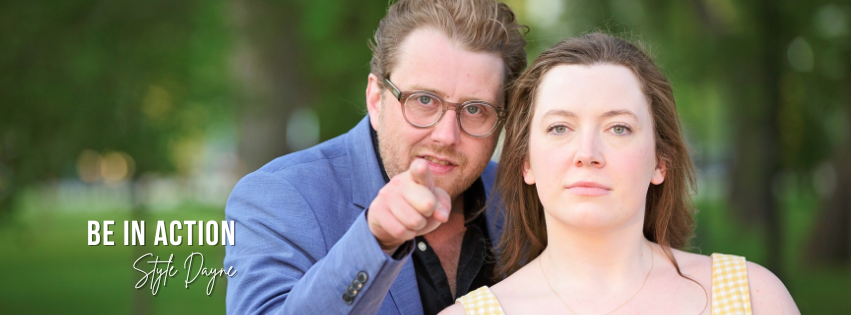
Why Actions Create Emotion, Not the Other Way Around
If preparation creates spontaneity, then the obvious next question becomes: what exactly are actors training?
For years, actors have been encouraged to think about emotion as the centre of the craft. We talk about feeling connected, feeling vulnerable, feeling truthful, and feeling present, as though our job is to become emotional archaeologists digging through ourselves in search of authenticity. Here’s a dose of hard reality. The audience doesn’t give a damn about how the actor feels. They crave actionable changes rooted in what the actor does. So, the question I ask everyone is “What does a Director say?”
They don’t call “Emotion.” They call “Action.” Meaning, the director is demanding actors be in action, in movement, doing something for the love of god.
That distinction matters more than most actors realize because it fundamentally changes what we train, how we rehearse, and ultimately what shows up when the camera starts rolling.
Wait — if you missed “The Myth of Spontaneous Acting” perhaps I should introduce myself.
I’m Style Dayne, a working actor and founder of SK’s premier Film/TV Actors Studio in Regina. I’ve spent close to twenty years working in front of the camera across projects including Words and Pictures opposite Clive Owen and Juillette Binoche, A Million Little Things, Batwoman, Motive, and a top billed role in Deadpool. When not on set I have spent my time in studio training with some of North America’s leading acting coaches in Vancouver (Actors Foundry and the Arts Club) Los Angeles (Graham Shiels), and New York City (Circle in the Square)
Along the way I’ve become obsessed with one question: what actually creates truthful work on camera? The answer I’ve come to is remarkably simple. Acting, despite our industry’s best efforts to complicate it, is still a verb.
Get in action and do something.
Acting functions in exactly the same way as the athletes we discussed previously. When the director says “Action,” that is not the moment to begin discovering how to listen, pursue, manipulate, defend, seduce, or shift tactics. That work should already be inside the actor, available without hesitation, because it has been trained repeatedly in environments that simulate pressure.
Set is game day and the audition is game day. The studio is practice and our rehearsal is our gym. That is where actors are building their core skill sets. The two should never be confused or conflated because each function entirely different from one another. In rehearsal, in our gym, we can explore different actions so we can execute with ease when the whistle blow. When the Director calls “Action.”
Do the right work
I saw the opposite of this once during a coaching session for a SyFy project. My client was auditioning for a principal role, one episode, 2 scenes. They arrived carrying what can only be described as an entire cinematic universe of backstory. There were journals, playlists, childhood trauma, and enough invented emotional history to justify its own series. None of it, however, was connected to the actual scene.
After listening for far to long, I asked a simple question: what are you trying to get from the other person in the scene, and how are you going to achieve that?
There was no answer. That was the issue. Not lack of effort, but misdirected effort. They had built an elaborate internal world but had not prepared for execution under pressure. When the work began, there was nothing to play, just a bunch of invented trama that the audience doesn’t care about.
That is the core misunderstanding. Actors often mistake emotional construction for preparation, when in reality it is frequently avoidance disguised as artistic integrity. It feels like work, but it never touches the actual demand of the scene, the demand of what we do.
Character is rooted in action
Stanislavski understood this clearly when he argued that character is defined through action, not adjectives or personality traits or carefully curated internal biographies that never enter the scene. The problem is that actors still default to describing characters as arrogant, insecure, broken, disheveled, or toxic, none of which are playable.
You cannot act arrogant but you can only act what arrogance does. One can dismiss, interrupt, undermine, or control. Those are actions, and those are what create behavior on screen.
Real people do not move through life conducting emotional analysis of themselves in real time. They pursue outcomes. They try to win arguments, protect relationships, avoid humiliation, gain approval, hold power, and navigate conflict. Human beings are active participants in their own lives, and actors are meant to mirror that behavior, not abstract it.
Action creates emotion
When actors commit fully to action, emotion tends to emerge as a byproduct rather than a target. It appears because something is at stake, not because it was manufactured. The frustration of not getting what you want, the relief of success, the fear of losing control, and the pressure of uncertainty are all natural consequences of pursuit when the objective actually matters.
Perhaps that is the great irony of acting: the harder an actor chases emotion, the more elusive it becomes. But give an actor something meaningful to pursue, something they are desperate to protect, win, avoid, control, or destroy, and emotion often arrives on its own.
Real people do not spend their lives trying to feel things. They spend their lives trying to do things. Actors should be no different.
There is no singular way to approach the craft, and every performer eventually develops their own rituals, processes, and tools. But one principle has survived every serious acting technique ever developed: if you are not in action, you are not acting.
So stop asking yourself how the character feels and start asking what the character wants. Stop chasing emotional states and start pursuing outcomes. Stop admiring the circumstance and start fighting for something inside it.
Because directors do not call out “Emotion.” They call out “Action.” And if you commit fully to the latter, the former usually takes care of itself.