



What athletes know that actors keep forgetting
A client of mine recently told me their cousin is competing on Team Ghana in FIFA, and I’ve been thinking about that a lot because it exposes something we still get wrong in this industry: preparation versus spontaneity.
Nobody looks at a FIFA athlete and assumes they’re improvising their way through the highest level of their sport, and nobody believes they’re simply “feeling it out” on game day. What we understand immediately is that what we are watching is the result of years of training, repetition, conditioning, and discipline. Yet in acting, we still tolerate a version of the opposite: that actors can simply show up, hear “Action,” and invent the work in real time.
That isn’t craft, it isn’t technique and it isn’t talent. It is gambling with somebody else’s time, resources, and trust.
Wait — you may not know me, so let me introduce myself.
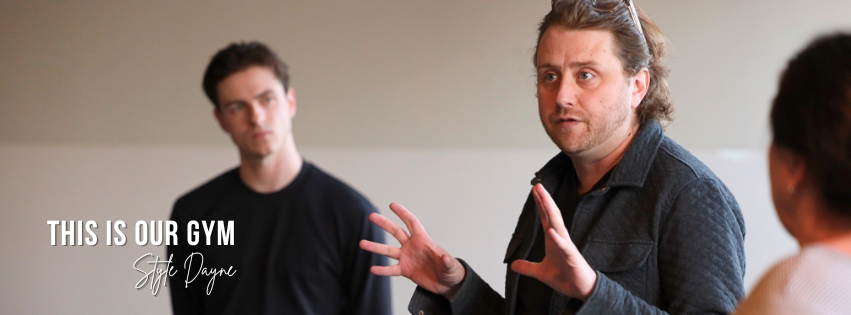
I’m Style Dayne: actor first, producer second, and creative entrepreneur when my work demands it. I’ve been working in front of the camera for close to two decades, and I now run a studio in Regina where we train actors for the realities of film and television work, including auditions, set environments, and the pace of a professional industry that does not slow down for preparation.
On camera, I’ve worked across projects including Deadpool, Batwoman, Supernatural, Motive, and Schmigadoon!, and I continue to work as an actor while building a studio focused on preparing the next generation of working performers in Saskatchewan and beyond. Over the years I’ve trained with some of the strongest coaches in North America, across Vancouver, Los Angeles, and New York City, and what I’ve taken from all of it is simple: the actors who last, who “make it” are the ones who train like the job is real, because it is.
Why spontaneity on set is only possible when it’s produced in practice.
I believe the studio is the practice field. It is the gym. It is a rehearsal space and training ground combined. It is where repetition happens, where failure is allowed, and where actors build the reflexes they will rely on later when the camera is rolling, the schedule is tight, and there is no time to “figure it out.”
That brings me back to the myth of spontaneity, which is one of the most misleading ideas still circulating in actors vernacular. It usually arrives in softer language, but it always points to the same assumption: “I’ll figure it out in the moment,” or “I don’t want to lock anything in,” or “I want to stay spontaneous.” What is often actually being said is something simpler and more concerning, which is that the work has not been built yet and the actor is hoping instinct will compensate for their lack of a confident skill set.
Spontaneity does not exist without preparation, and in truth it cannot. What looks like spontaneity on screen is always the result of repetition and rehearsal so ingrained that the performer is no longer thinking about mechanics. That is true in sport, and it is true here.
If we return to the FIFA example, the point becomes clearer. Players are not consciously deciding how to run, how to kick, or how to position themselves with each moment of play. They are responding in real time to changing conditions, making thousands of micro-decisions based on what is unfolding in front of them. The difference is that those decisions are not invented in the moment; they are executed from training that already exists in their body. Their freedom comes from preparation, not from the absence of it.
Finding the freedom to let us be spontaneous
Actors love talking about freedom, instinct, and spontaneity, but freedom has never existed in opposition to preparation. The greatest athletes in the world are not free because they avoided training; they are free because they trust it. Their bodies know what to do long before their minds have time to catch up.
Acting works the same way.
The studio is the practice field. Rehearsal is the gym. The work audiences describe as “natural” is almost always the product of thousands of repetitions nobody ever sees. Listening, pursuing, adapting, shifting tactics, raising stakes, recovering from failure. These are skills, and skills are built through training.
Professional actors do not rise to the occasion. They fall back on their preparation, because when the whistle blows and the director calls “Action,” game day has already started. The schedule is moving, the crew is waiting, and nobody is interested in watching an actor search for the work in real time.
Game day is not for discovery, game day is for execution.